Download Case Study as PDF
Overview
At The Royal Marsden NHS Foundation Trust, in collaboration with The Institute of Cancer Research (London, UK), a planning study explored a simulation-free pre-treatment workflow for prostate MR-guided online adaptive radiotherapy [1]. Traditionally, treatment planning requires a dedicated simulation scan, which can add weeks of waiting before patients begin treatment. This work used diagnostic MR scans instead, mimicking an MR-only prostate online adaptive radiotherapy workflow on the Elekta Unity MR-Linac to assess suitability for reference plan generation.
Context
- Site: The Royal Marsden / The Institute of Cancer Research (London, UK)
- System: 1.5T MR-Linac (Unity, Elekta AB)
- Patient cohort: Patients treated with 36.25 Gy in 5 fractions within the HERMES trial
- Clinical setting: Online adaptive radiotherapy (oART), where the reference plan serves as a template for plan adaptation
Objective
To test whether non radiotherapy-dedicated diagnostic MRI can be used for reference prostate planning on the MR-Linac, generating adapted plans equivalent to those clinically delivered.
Method
Previous imaging was reviewed for all 5-fraction patients treated within the HERMES trial to assess eligibility. A total of 21 out of 24 patients had diagnostic imaging suitable for reference planning.
If eligible:
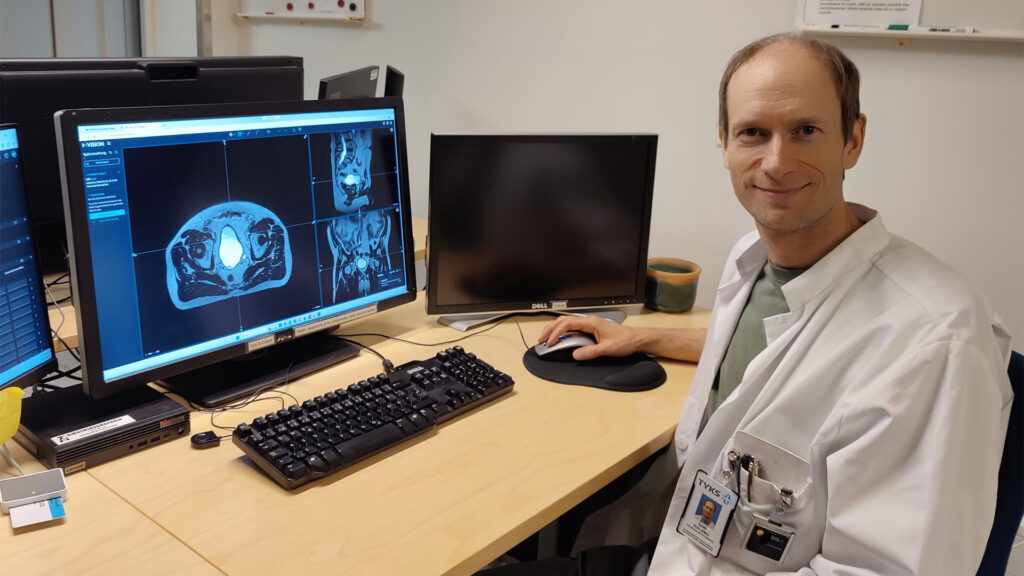
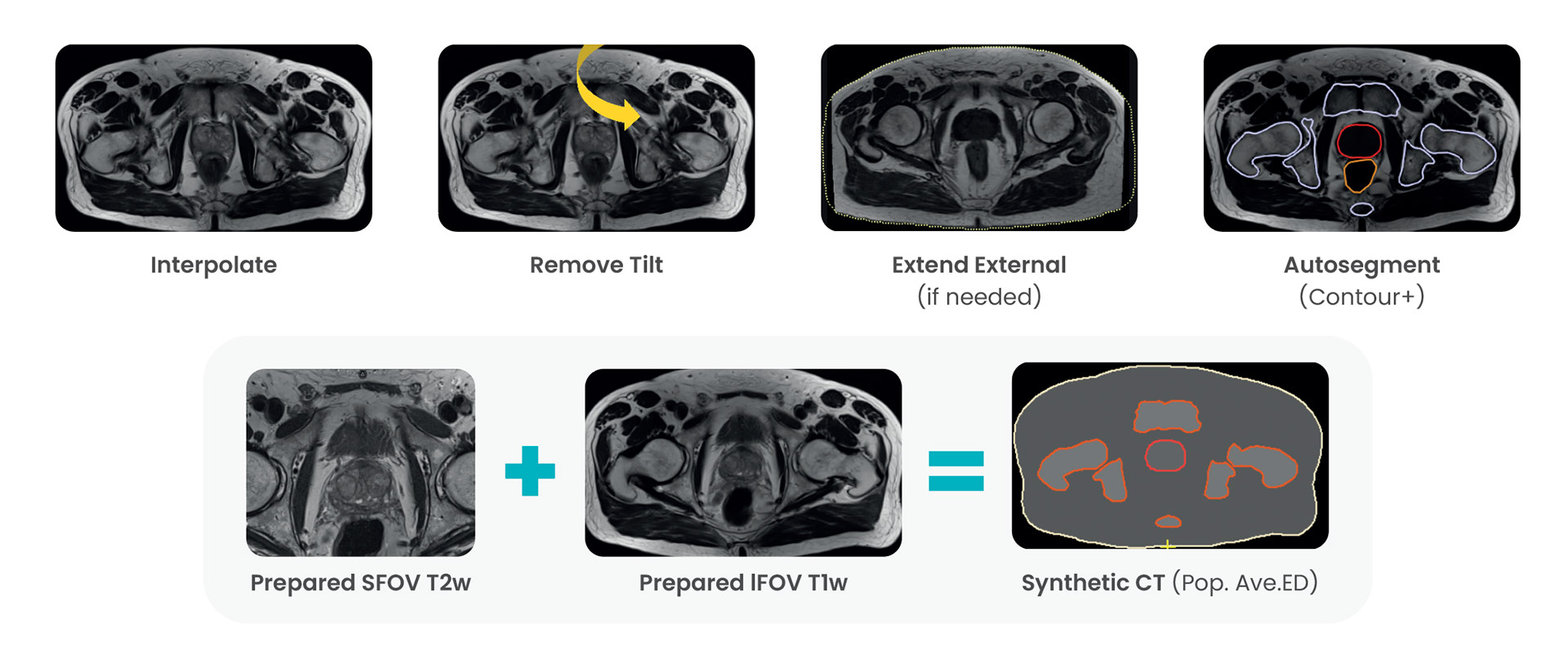
- Diagnostic MR images were prepared to enable MR-only reference planning (interpolation, tilt removal, external extension of the image where FOV did not include entire patient).
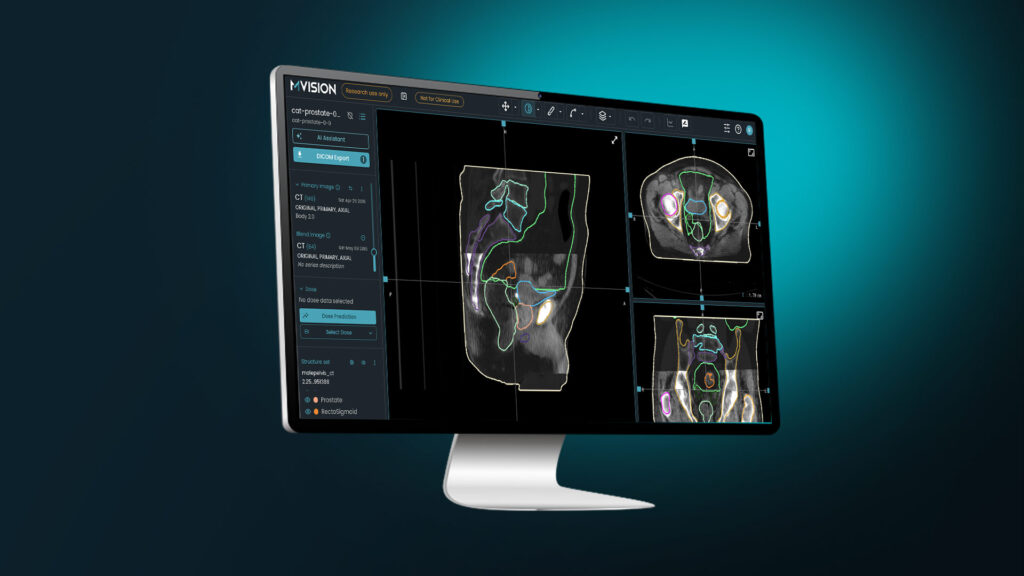
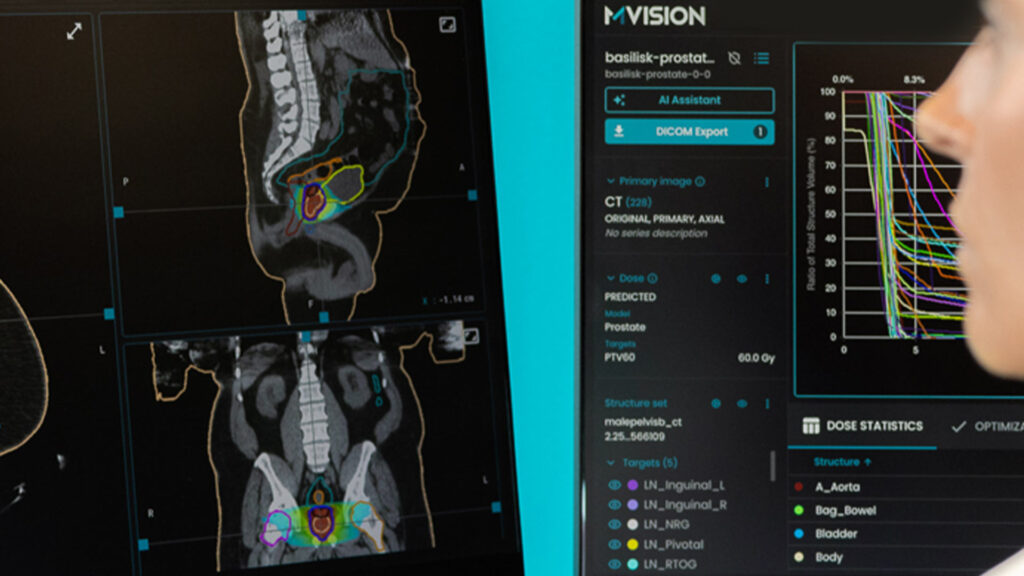
- Target and organ-at-risk reference structures were autosegmented using Contour+ without clinician input.
- A synthetic CT was created using population average electron density.
- MR-Linac reference plans were generated as per HERMES protocol on the generated synthetic CT images.
- Online plan adaptation was simulated using existing clinical treatment images and structure sets.
- The new “simulation-free” adapted plans were compared with existing clinical adapted plans.
Results
- All reference images and treatment plans were successfully created.
- All adapted treatment plans:
– achieved target dose and conformality
– met all mandatory clinical goals
– showed no detriment to organ-at-risk dose or plan deliverability - Synthetic CT accuracy was high, with 2mm/2% gamma results above 98.9%.
Conclusion / Why it matters
This study has shown that diagnostic MRI can be used for reference prostate planning on the MR-Linac. Diagnostic MR images generated adapted plans equivalent to those clinically delivered that originated from radiotherapy-simulation reference plans.
Using diagnostic MR for reference planning can save weeks in the radiotherapy pathway of high volume departments, possibly improving treatment efficiency and patient experience.
Next steps
- Use in controlled trials for prospective validation
- Continued development of more rapid, adaptive and cost-effective pathways
- Expansion beyond prostate indications
- Further integration of autosegmentation to support simulation-free workflows
Reference
- Published in Radiotherapy and Oncology. DOI: 10.1016/j.radonc.2025.111053